

New EU Rules Against Greenwashing
EmpCo: New requirements for environmental and sustainability claims
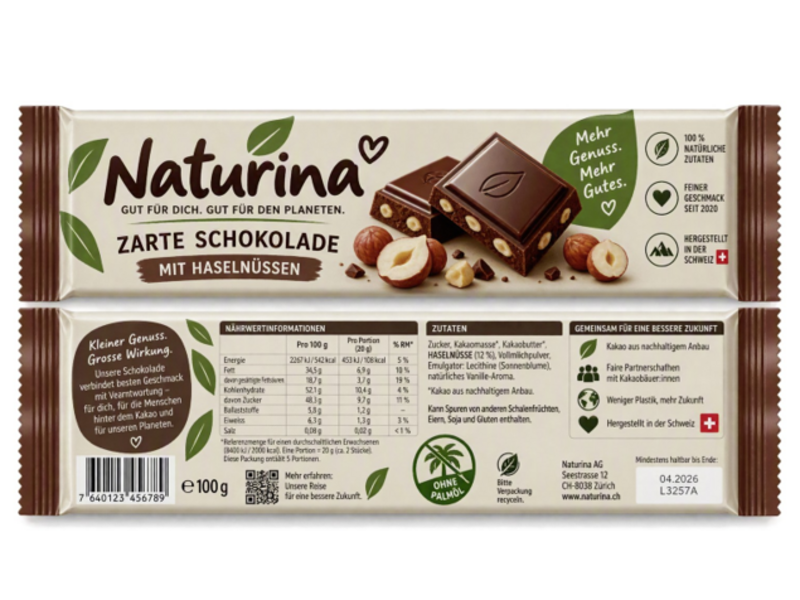
Fictional chocolate example featuring sustainability claims that must be verified under the new EmpCo regulations.
New EU legislation introduces stricter requirements for sustainability claims while also offering the opportunity to substantiate them transparently and with legal certainty through certification.
The EU Directive «Empowering Consumers for the Green Transition» (EmpCo) significantly strengthens the requirements for environmental, climate and sustainability claims made to end consumers, thereby affecting all industries. Its aim is to prevent greenwashing and ensure transparent, verifiable information that enables consumers to make informed purchasing decisions.
Relevant for Switzerland too
The new provisions have applied since 27 September 2026 and also affect Swiss companies that market their products in the European Union. In addition, Swiss legislation already creates a need for action. Since 1 January 2025, a provision of the Environmental Protection Act has required claims relating to climate impacts to be based on objective and verifiable evidence. This applies, for example, to environmental and climate claims on packaging, websites, online shops and other marketing materials. The EmpCo rules go further, also covering general environmental claims, sustainability labels, product comparisons, social claims and certain future-oriented commitments.
Swiss companies are therefore advised to review existing claims and labels on packaging, websites and marketing materials at an early stage (see information box). Particular attention should be paid to the absence of a transition period: advertising claims and sustainability labels already in use must comply with the new requirements. This may also affect packaging and labelling on products that are already on the market.
Independent certification provides clarity
For companies, this means that claims such as "sustainable", "environmentally friendly" or "climate neutral" must be clearly substantiated and verifiable. A central element of the new EU regulations is the independent third-party verification of environmental and sustainability claims, as well as private standards and labels. An independent, officially recognised certification body must therefore assess communications against the applicable requirements, verify the supporting evidence and confirm the claims being made. This creates transparency and builds trust among customers and business partners while reducing the risk of complaints and challenges.
Swiss certification body bio.inspecta AG specialises in the assessment of public and private standards and labels. Rrahmon Hoxha, Head of Processing and Trade, explains the services available considering the new regulation: "We support companies and service providers in verifying their sustainability communications by reviewing claims, supporting evidence, labels and logos. In doing so, we lay the foundation for credible communication."
Practical example: Chocolate
A fictional but realistic example involving a chocolate product illustrates the scope of the new regulation.All claims must be supported by relevant and verifiable criteria and confirmed by an independent body (an accredited certification body).
The "palm oil free" label on the chocolate falls within the scope of the EmpCo Directive. It is not an official certified label, and its design suggests a connection with the RSPO label, which features a similar image of palm leaves. Claims relating to cocoa from sustainable cultivation must also be verified in accordance with the EmpCo directive. The statements "Small treat. Big impact – for the people behind the cocoa" and "Fair partnerships with cocoa farmers" promote a social commitment that would also fall within the scope of the EmpCo Directive. Furthermore, the claim "Less plastic, more future" would not be permitted in this form.
Organic products are also affected
Established organic certification systems are based on defined requirements and independent inspections. However, organic certification only confirms compliance with the relevant organic standard. It does not automatically constitute proof that a product is "climate neutral", "environmentally friendly" or "sustainable" in a broader sense.
Such additional claims must be substantiated separately, using evidence appropriate to their specific content.
Environmental, climate and sustainability claims
Make general claims more specific
- Terms such as "sustainable", "environmentally friendly" or "climate friendly" must not be used as broad, unqualified statements.
- Instead of claiming "environmentally friendly packaging", a company could state: "The cup is made from 80% recycled cardboard. The lid and label are excluded."
- An environmental benefit must not be attributed to an entire product or company if it relates only to the packaging, a raw material, a particular site or an individual processing step.
- For example, if a processing facility uses electricity exclusively from renewable sources, the claim must be limited to that facility and the relevant processing step.
- Product-related claims such as "CO₂ neutral" are prohibited if they are based solely on offsetting emissions outside the value chain..
- More appropriate alternatives are specific, verifiable statements such as: "Since 2022, we have reduced energy consumption per tonne produced by 15%."
- Voluntary private labels, logos and quality marks highlighting environmental or social characteristics must be based on a transparent certification scheme involving independent third-party verification.
- Characteristics that are irrelevant to a product or already required by law must not be presented as advantages.
- One example cited in the Directive is advertising water as "gluten free". The same applies to claiming that a product does not contain a substance already prohibited across the entire product category.
- Claims such as "climate neutral by 2030" require a realistic, publicly accessible implementation plan with measurable interim targets, allocated resources and independent verification of progress by an independent external expert.
Peter Jossi, published in Lebensmittel-Industrie magazine, October 2026